
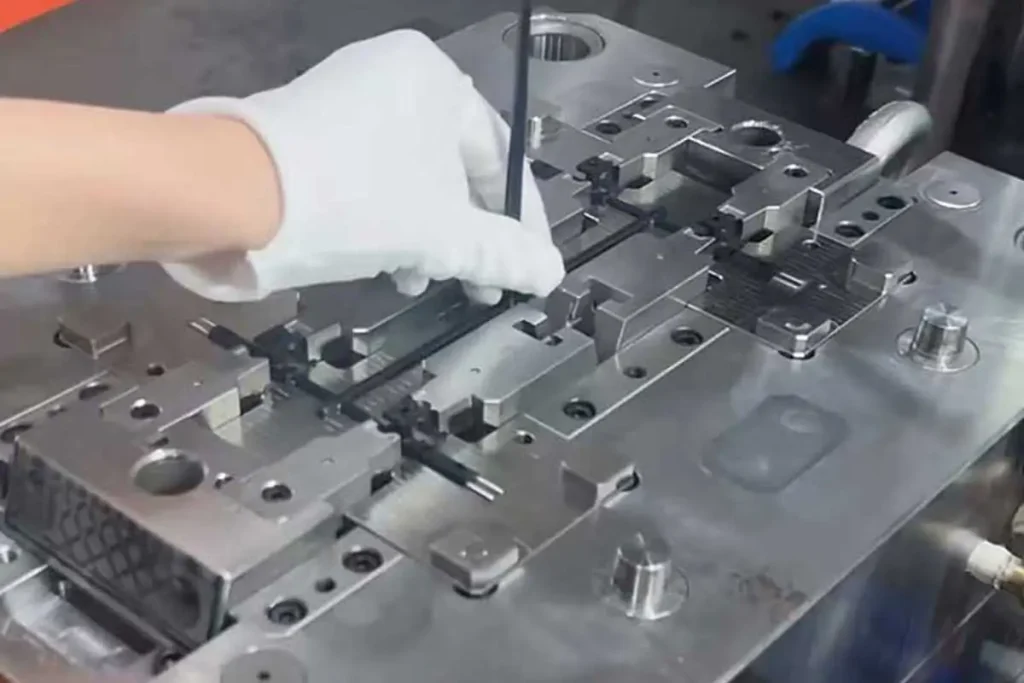
Injection mold development is a systematic engineering process, with the core logic being “Design → Machining → Validation → Mass Production.” The specific workflow is outlined below.
1. Product Analysis and Mold Design
Product Analysis and Confirmation: Based on the customer’s product drawings or samples, clarify three core elements: product material, quantity, and appearance/dimensional requirements. Simultaneously confirm details such as draft angles, radii, and hole positions.
Quotation and Contract Signing: Prepare a quotation based on product complexity, mold material, machining precision, and delivery timeline. After mutual confirmation, sign the contract specifying mold acceptance criteria, payment terms, and post-sales warranty.
Mold Design Proposal Review: Engineers present the Mold Structure Design Proposal, including core dimensions, cavity count (single/multi-cavity), gate system (material flow method), cooling system (temperature uniformity), ejection system (damage-free demolding), and venting system (bubble prevention). Upon client approval, formal design commences.
2. Mold Structure Design (Core Process: Digital Modeling)
3D Mold Modeling: Complete full 3D mold design based on product drawings, encompassing all components including fixed mold, moving mold, inserts, slides, ejector pins, guide pins, etc. Ensure reasonable clearance between parts with no interference or dead angles.
2D Engineering Drawing Output: Convert 3D models into 2D engineering drawings, annotating dimensions, tolerances, materials, and machining requirements for each component. These serve as the sole standard for subsequent manufacturing processes, alongside generating the Bill of Materials (BOM).
Final Design Review: Re-verify 3D models, 2D drawings, and product requirements, focusing on demolding feasibility, cooling uniformity, and venting effectiveness to prevent rework caused by design flaws (e.g., product cracking due to improper ejector pin placement).
3. Mold Manufacturing (Implementation Phase, Precision Control)
This step transforms design drawings into physical components, following the sequence: “rough machining → precision machining → surface treatment.” Core components include core inserts, fixed plates, moving plates, and slides:
Rough Machining: Remove excess material through milling, planing, and drilling to achieve preliminary part contours.
Finishing (Core stage determining mold precision): Utilizes CNC milling, EDM (Electrical Discharge Machining), WEDM (Wire Electrical Discharge Machining), and other processes to refine component dimensions and ensure precision meets requirements.
Surface Treatment: Applies treatments to mold inserts based on product needs—polishing for standard products, mirror polishing for high-gloss items, and nitriding for wear-resistant applications.
Component Inspection: Utilizing precision instruments like coordinate measuring machines and projectors, each component’s dimensions and accuracy are individually verified. Non-conforming parts are immediately reworked to prevent post-assembly issues.
4. Mold Assembly (Integration Phase, Ensuring Smooth Interactions)
All qualified components are assembled into a complete mold according to design drawings. The core focus is achieving “reasonable clearance and smooth motion”:
5. Mold Trial Run
Install the assembled mold onto an injection molding machine for trial production. The primary objectives are to verify mold compliance with product requirements and identify potential issues:
6. Mold Acceptance & Delivery (Final Phase: Handover for Mass Production)
If acceptance fails, rectify per customer requirements until standards are met. Upon successful acceptance, both parties sign the acceptance form.
Mold Delivery: Transfer the mold and delivery documentation to the customer, accompanied by training (e.g., mold installation, routine maintenance, basic troubleshooting).
7. Post-Delivery Support & Maintenance (Extending Mold Lifespan)
Routine Maintenance: Guide customers in regularly cleaning the mold, lubricating moving parts (guide pins, slides), and inspecting the cooling system to prevent rust and jamming.
Troubleshooting & Repair: Address mold issues arising during mass production (e.g., core wear, ejector pin breakage, water leaks) through prompt on-site repair or return for repair.
Welcom to contact us any time.
